
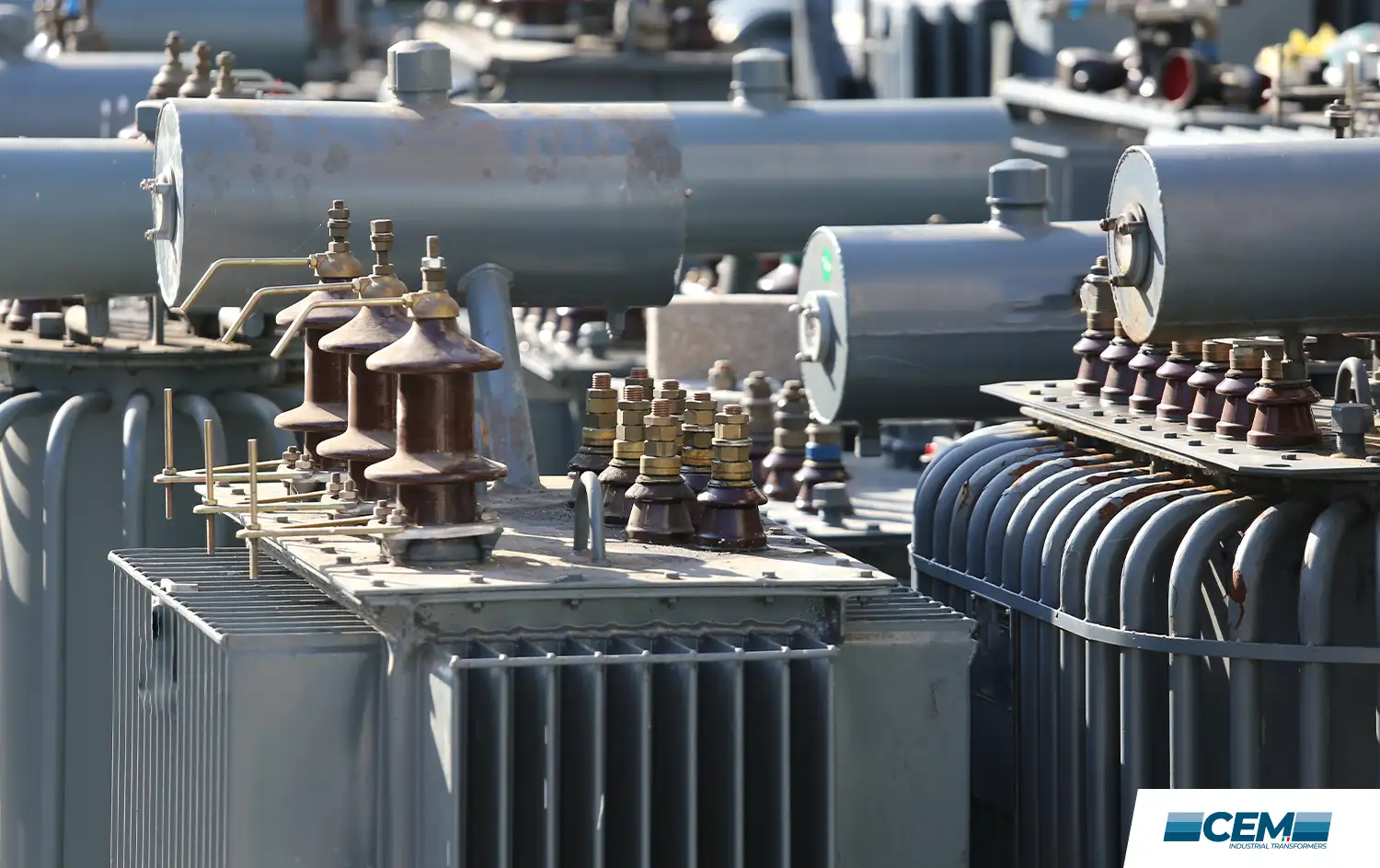
Most discussions of power transformers focus on the standard distribution and transmission units that form the backbone of the electricity grid. But a substantial and technically demanding segment of the transformer market lies beyond these conventional categories: special transformers, engineered for applications where standard design approaches are inadequate and where the consequences of poor specification or premature failure are severe.
Special transformers including furnace transformers, rectifier transformers, phase shifting transformers, converter transformers, and a range of other custom-engineered units serve the most demanding industrial and power system applications. This guide covers the main types, their defining characteristics, the engineering principles behind their design, and what to look for when specifying or maintaining them.
What makes a transformer ‘special’?
The term ‘special transformer’ describes any transformer designed for an application that imposes requirements outside the scope of standard power transformer design. These requirements may involve:
- Non-sinusoidal currents: rectifier and converter transformers must handle AC currents heavily distorted by harmonic components from power electronics.
- Extreme operating conditions: furnace transformers must withstand violent load cycling, frequent short circuits, and continuous overloads that would rapidly destroy a standard distribution transformer.
- Custom voltage or current ratios: special process applications often require voltage levels, current magnitudes, or phase relationships that have no standard equivalent.
- Phase-shifting: some applications require a controlled phase angle difference between primary and secondary voltage, with no counterpart in standard transformer design.
- Multi-winding designs: several special transformer applications require three, four, or more separate secondary windings, often at different voltages and phase angles.
- Integration with power electronics: converter and rectifier transformers are designed as an integral part of a converter system, with impedance, winding arrangement, and commutation reactance all matched to the specific power electronic topology.
A special transformer is not a standard transformer used in a non-standard application. It is a purpose-engineered unit whose core design, winding arrangement, insulation system, and mechanical structure are all optimised for the specific operating conditions it must endure.
Furnace transformers: the core of electric steelmaking
Furnace transformers are perhaps the most recognisable category of special transformers, serving the electric arc furnace (EAF) and ladle furnace (LF) in electric steelmaking and other metallurgical applications. They are the defining product of CEM Engineering’s portfolio and the transformer type that most clearly illustrates the difference between standard and special design.
The demands on a furnace transformer are unlike any other transformer application. An EAF transformer must deliver maximum power during an intensive melting phase characterised by thousands of short-circuit events per day, violent load cycling between zero and full load as the arc strikes and extinguishes, current magnitudes that can reach tens of thousands of amperes on the secondary side, and a requirement for 120% short-term overload capability. All of this must be sustained reliably across a service life of 25 or more years, often in a difficult industrial environment.
As documented in the technical literature including the Electrical Engineering Portal’s overview of special industrial transformers DC EAF transformers (which combine furnace and rectifier functions) operate under even more severe conditions than standard AC EAF units, requiring the most robust construction available in the transformer industry.
CEM Engineering specialises in furnace transformer engineering and support. We provide specification advice, procurement support, diagnostic services, OLTC maintenance, winding inspection, and emergency technical support for EAF and LF transformers across the global steelmaking industry.
Rectifier transformers: AC-to-DC power for industrial processes
Rectifier transformers provide the interface between the AC power supply and the rectifier system the diodes or thyristors that convert alternating to direct current for industrial electrochemical processes, DC motor drives, and railway traction substations. They are another core specialisation of CEM Engineering, and are covered in detail in our dedicated rectifier transformer guide.
The key design challenge for rectifier transformers is the non-sinusoidal secondary current generated by the rectifier’s switching action. This harmonic content creates additional losses, thermal stress, and power quality problems that standard transformer designs do not account for. The solution — multi-secondary, phase-shifted winding arrangements that allow harmonic cancellation, is the engineering heart of modern rectifier transformer design.
Applications range from very large aluminium electrolysis potlines consuming hundreds of megawatts at currents of hundreds of thousands of amperes, to electrochemical chlor-alkali plants, copper electrowinning and electrorefining facilities, large DC motor drives for rolling mills and mine hoists, and DC traction substations for metropolitan railways and tramways.
Converter Transformers: powering variable speed drives and SVC systems
Converter transformers serve large variable speed drive systems, including rolling mill drives, mine hoists, large pumping stations, and wind tunnel installations, as well as static var compensators (SVC) and static frequency converters (SFC). As described in the Electrical Engineering Portal’s technical overview, converter transformers for large drive applications are typically built in double-tier configuration, with two secondary windings to enable 12-pulse operation and the associated harmonic reduction.
The specific challenge of converter transformer design is that the thyristor switching action generates current waveforms that impose unusual voltage stress patterns on the winding insulation, stress that differs significantly from the conditions assumed in standard transformer insulation design and testing standards. Converter transformers must be designed and tested with explicit attention to these non-standard electrical stresses.
Additional complexity arises from the fact that converter transformers often operate in specific critical conditions, including defined short-circuit conditions during thyristor commutation, and may be subject to very high-frequency voltage transients from thyristor switching that can stress the inter-turn insulation in ways that standard overvoltage testing does not reveal.
Phase Shifting Transformers: Managing power flow in complex networks
Phase shifting transformers (PSTs) are used to control active power flow in meshed transmission and distribution networks. By introducing a controllable phase angle between primary and secondary voltage, they redirect power flow between parallel network paths preventing overloads on congested routes and optimising the utilisation of transmission infrastructure. As explained in Electricalsphere’s technical overview, a PST works by injecting a phase-shifted voltage into the transmission line through a series-connected transformer, fed from a shunt transformer that is connected in parallel with the line.
PSTs are increasingly deployed as transmission networks become more complex under the influence of variable renewable generation and cross-border power trading. They are large, mechanically complex units whose tap changers must operate under the unique electrical stresses of phase-shifted voltages and currents a significantly more demanding regime than the OLTC service conditions of a standard power transformer.
The mechanical design of PST tap changers is a specialised engineering discipline. The contact break current and voltage conditions at phase-shifted angles differ from those of a standard OLTC, and the mechanical maintenance requirements reflect this greater complexity.
Autotransformers: Voltage adjustment without isolation
Autotransformers use a single winding with multiple taps to achieve voltage transformation without galvanic isolation between input and output. As noted in Maddox Transformer’s technical resources, they are often employed as a cost-effective substitute for two-winding transformers in applications where isolation is not required, providing voltage adjustment for industrial machines, motors, compressors, and other equipment with specific voltage requirements.
In industrial applications, autotransformers are used for motor soft-starting (reducing inrush current during start-up), voltage matching between equipment with different voltage ratings, and in large power systems for interconnecting networks at closely related voltage levels (e.g., 400 kV / 230 kV autotransformers in transmission systems). At high power ratings, autotransformers offer material cost and loss advantages over equivalent two-winding designs, savings that scale with the transformer’s MVA rating.
The absence of galvanic isolation is the critical limitation of autotransformer application. Fault currents and transient overvoltages can propagate from the connected network directly through the autotransformer winding, a risk that must be assessed carefully in the protection system design.
Welding Transformers and other industrial special types
Beyond the major categories above, the special transformer family includes a range of application-specific units:
- Welding transformers: step-down units specifically designed for resistance and arc welding applications, characterised by very high secondary current at very low voltage, and designed for the highly cyclic, intermittent duty of welding processes.
- Traction transformers: units installed in electric locomotives or multiple-unit trains to step down the overhead line voltage to the levels required for traction motors and auxiliary systems. These operate in a harsh vibration environment and must meet specific railway standards.
- Grounding transformers (zigzag transformers): used to provide a neutral point in delta-connected or ungrounded systems, enabling single-phase-to-ground fault current to flow in the system protection scheme.
- Scott-T transformers: convert three-phase power to two-phase power, used in some railway traction and industrial applications requiring balanced two-phase supply.
- Isolation transformers for sensitive loads: purpose-designed units providing very high levels of galvanic isolation, low leakage inductance, and electrostatic shielding for medical equipment, laboratory instruments, and sensitive electronic systems.
Engineering requirements common to all Special Transformers
Across all categories of special transformers, certain engineering principles apply consistently. Understanding these principles is essential for anyone responsible for specifying, purchasing, or maintaining special transformer equipment:
Application-specific winding design
The winding design must be optimised for the specific current waveform, thermal loading pattern, and mechanical stress regime of the application. This is not achievable by modifying a standard winding design, it requires analysis of the specific operating conditions from the outset of the design process.
Short-circuit withstand
Most special transformer applications involve elevated risk of short-circuit events whether from rectifier commutation, furnace electrode-to-scrap contact, or converter fault conditions. The winding structure must be designed, built, and verified to withstand the peak electromagnetic forces generated by the worst-case short circuit, in accordance with IEC 60076-5.
Thermal design under non-standard load profiles
Standard transformer thermal models assume sinusoidal currents and specific duty cycles. For special transformers, the actual thermal loading including harmonic heating in rectifier and converter transformers, or the cyclic peak loads of furnace transformers must be explicitly modelled in the design to ensure that winding hotspot temperatures remain within safe limits under all operating conditions.
Insulation coordination
Non-standard voltage stress patterns including the DC component in rectifier transformer windings, the phase-shifted voltages in PST windings, and the high-frequency transients from power electronic switching require specific insulation coordination analysis. Standard impulse and power-frequency tests may not be sufficient; additional tests specific to the application may be required.
Testing and factory acceptance
Special transformers require factory acceptance test programmes that go beyond the standard routine and type tests specified in IEC 60076. The specific tests required depend on the application: harmonic loss measurement for rectifier transformers, phase angle verification for PSTs, short-circuit test for furnace transformers. Defining the test programme explicitly in the purchase specification is essential to ensure the delivered unit performs as designed. Our quality and testing capability at CEM Engineering is built around the specific requirements of the special transformer applications we serve.
Maintenance of Special Transformers: Why standard approaches fall short
The maintenance of special transformers requires the same application-specific understanding that their design demands. A maintenance engineer applying standard distribution transformer maintenance intervals and procedures to an EAF transformer will systematically underservice the unit the OLTC will wear faster, the winding clamping will loosen more rapidly, and the insulation will age more quickly than the standard programme anticipates.
Our service team at CEM Engineering provides maintenance services specifically designed for special transformer applications. We understand the operating conditions that our clients’ transformers face because we are the engineers who specified and procured them. That context allows us to design maintenance programmes that are calibrated to the actual duty cycle, load profile, and risk exposure of each unit.
We provide Dissolved Gas Analysis, OLTC maintenance, winding inspection, thermographic survey, and full refurbishment services for EAF transformers, LF transformers, rectifier transformers, and converter transformers, with 24/7 emergency support for critical industrial clients in Europe and North America.
Why choose CEM engineering for Special Transformer engineering and support
We exist in this market because special transformers require special expertise. General-purpose transformer suppliers and maintenance contractors do not typically have the depth of application knowledge that EAF, LF, rectifier, and converter transformer applications demand. Our entire focus is on the most technically challenging segment of the transformer industry which means our clients benefit from engineering judgement built on genuine operational experience.
We operate from our facility in Cologno al Serio, Bergamo (Italy), with a US presence in Coraopolis, PA, and maintain a winding shop capable of producing custom copper windings for new build and refurbishment programmes. ISO 9001-certified processes, 24/7 technical availability, and an engineering team with over 20 years of special transformer experience make CEM the partner of choice for demanding industrial transformer challenges.
To discuss a special transformer project, specification, or service requirement, contact our engineering team.
FAQ – Special Transformers
What is the difference between a special transformer and a standard power transformer?
A standard power transformer is designed for sinusoidal currents, steady-state load, and the well-defined electrical stress conditions of utility distribution or transmission service. A special transformer is purpose-engineered for applications that impose conditions outside this scope non-sinusoidal currents, extreme load cycling, phase-shifted voltages, very high current magnitudes, or integration with power electronic systems.
Do special transformers follow the same IEC standards as standard transformers?
Special transformers are designed in accordance with IEC 60076 as the base standard, but are subject to additional requirements specific to their application type. Rectifier transformers reference IEC 61378; converter transformers have additional insulation coordination requirements; furnace transformers require specific short-circuit withstand verification. The purchase specification must explicitly define all applicable standards and additional test requirements.
How is a converter transformer different from a rectifier transformer?
A rectifier transformer supplies a rectifier system (diodes or thyristors) for AC-to-DC conversion in electrochemical or DC motor drive applications. A converter transformer is a broader term covering transformers for any power electronic converter including rectifiers, inverters, frequency converters, and SVC/STATCOM systems. All rectifier transformers are converter transformers, but not all converter transformers are rectifier transformers.
What makes furnace transformer maintenance different from standard transformer maintenance?
Furnace transformers experience far more severe operating conditions than standard power transformers: hundreds of short-circuit events per day, rapid load cycling, continuous overload operation, and high OLTC switching frequency. Maintenance programmes must reflect this accelerated wear rate with OLTC maintenance intervals calibrated by operation count, winding inspection at five-year intervals, and DGA every three to six months rather than annually.
Can CEM Engineering support special transformers from other manufacturers?
Yes. Our service activities cover EAF, LF, rectifier, and converter transformers regardless of the original manufacturer. We provide DGA analysis, OLTC maintenance, winding inspection, failure analysis, and refurbishment services for any oil-immersed special transformer in industrial service. Our focus is on the application and the engineering not on the brand on the nameplate.