
Industrial transformers are a distinct and technically demanding category of electrical equipment. They are not distribution transformers used in industrial buildings. They are purpose-engineered units designed to serve the most demanding electrical applications in heavy manufacturing electric arc furnaces, electrolytic cells, DC motor drives, rolling mills, mining operations, and chemical production processes, where the operating conditions would rapidly destroy a conventional power transformer.
This guide covers the main categories of industrial transformer, what distinguishes them from standard power units, the sectors where they operate, the failure modes that affect them in service, and how CEM Engineering supports industrial transformer owners across the complete asset lifecycle.
What makes a transformer industrial?
The term ‘industrial transformer’ is used in two senses. In the broad sense, it refers to any transformer that serves an industrial facility a definition that includes standard distribution transformers supplying factories, warehouses, or process plants. In the specific technical sense, the sense used throughout this guide, it refers to transformers designed and engineered for the non-standard electrical conditions of heavy industrial processes.
These conditions include:
- Non-sinusoidal load currents: rectifiers, converters, and power electronic drives create heavily distorted current waveforms containing significant harmonic content. Standard transformer designs are not rated for the additional losses these harmonics create.
- Extreme load cycling: electric arc furnaces impose violent load variations, from near short-circuit to rated load and back, across a cycle of seconds, repeated thousands of times per day. Standard transformers are designed for steady-state or slowly varying loads.
- Very high secondary currents at low voltages: electrochemical processes and arc furnace applications require currents of tens of thousands of amperes at secondary voltages of a few hundred volts. Standard transformer LV designs cannot accommodate these current magnitudes.
- Continuous full-load duty: many industrial processes electrolysis, chemical reactors, DC motor drives require the transformer to operate at or near full rated load continuously, with no thermal recovery period.
- Short-circuit exposure: arc furnaces and converter systems create frequent short-circuit events that the transformer must absorb without mechanical or electrical damage. Standard short-circuit withstand requirements are insufficient for these duty cycles.
An industrial transformer is not an uprated standard transformer. It is a purpose-engineered product whose winding design, insulation coordination, mechanical structure, and cooling system are all calibrated for the specific process it serves. Substituting a standard unit creates predictable failure.
The main categories of industrial transformer
EAF Transformers – Electric Arc Furnace
The EAF transformer is the electrical heart of electric arc furnace steelmaking one of the most power-intensive industrial processes in operation. Rated from approximately 20 MVA for smaller foundry furnaces to over 200 MVA for large mini-mill installations, these units must deliver maximum power during an intensive melting phase characterised by thousands of short-circuit events per day, violent load cycling, secondary currents reaching tens of thousands of amperes, and a requirement for sustained 120% overload capability.
CEM Engineering’s EAF transformer engineering and service capability covers the full lifecycle of these units from specification and procurement through preventive maintenance, OLTC refurbishment, winding inspection, DGA analysis, and emergency support. We are one of the few independent engineering organisations with genuine depth in EAF transformer applications, rather than general power transformer experience applied to a furnace context.
Ladle furnace transformers – secondary steel metallurgy
The ladle furnace transformer powers the secondary metallurgy stage of the steelmaking process the LF station where liquid steel is refined, homogenised, and brought to the precise temperature and chemical composition required for casting. Rated typically between 8 MVA and 40 MVA, LF transformers operate in a more controlled arc heating mode than EAF units, but require precision voltage regulation and robust short-circuit withstand capability. Full technical coverage is available in our dedicated LF transformer guide.
Rectifier transformers – AC-to-DC industrial power
Rectifier transformers interface between the AC supply network and rectifier systems the diodes or thyristors that convert AC to DC for electrochemical processes, DC motor drives, and railway traction substations. Their defining design challenge is the non-sinusoidal secondary current created by the rectifier’s switching action, which must be addressed through multi-pulse, phase-shifted winding configurations that minimise harmonic injection into the supply network. Aluminium smelters, chlor-alkali plants, copper electrowinning facilities, and large industrial motor drive systems are the primary applications. Our rectifier transformer guide provides detailed technical coverage.
Converter and drive transformers
Converter transformers serve large variable speed drive systems rolling mill drives, mine hoists, large pumping installations, wind tunnel drives, and static var compensators. They face specific design challenges from thyristor switching action, which imposes unusual voltage stress patterns on the winding insulation that differ from those encountered in standard transformer service. Converter transformers are typically designed for 12-pulse operation using two secondary windings, providing harmonic cancellation and improved DC bus quality.
Industrial supply transformers
Every large industrial facility requires power supply transformers to step down the incoming grid voltage (typically 33 kV, 66 kV, or 132 kV) to the voltage levels required for its processes and building services. These medium power transformers must be specified with awareness of the harmonic environment created by the facility’s non-linear loads rectifiers, variable speed drives, arc furnaces and with appropriate impedance and insulation design for the fault current levels of the industrial network. See our medium power transformer guide for full specification guidance.
Industrial transformers by sector
| Industrial Sector | Primary Transformer Types |
| Electric steelmaking (EAF route) | EAF transformer (melting), LF transformer (refining), rectifier transformer (DC auxiliary processes), industrial supply transformers |
| Aluminium smelting (electrolysis) | Very large rectifier transformers (60-pulse configurations), supply transformers for auxiliary loads |
| Chemical / chlor-alkali | Rectifier transformers for electrolysis cells, isolation transformers for process control |
| Copper / zinc electrowinning | Rectifier transformers, supply transformers for agitation and pumping loads |
| Mining and minerals processing | Converter transformers for large hoists and winders, rectifier transformers for electrowinning, motor starting autotransformers |
| Rolling mills and metal forming | Converter/drive transformers for DC mill drives, supply transformers for high-harmonic VSD loads |
| Railway traction (DC) | Rectifier transformers for 750 V, 1,500 V, or 3,000 V DC traction substations |
Why industrial transformers fail prematurely
Industrial transformers fail earlier than their design life for predictable, preventable reasons. Understanding these failure mechanisms is the foundation of an effective maintenance programme:
- Inadequate specification: a transformer specified without accounting for the actual harmonic content of the load, the peak overload requirements, or the short-circuit duty cycle will be thermally and mechanically stressed beyond its design limits from the first day of operation.
- OLTC neglect: the on-load tap changer in an EAF or LF transformer operates hundreds of times per day orders of magnitude more than in utility substation service. Maintenance intervals designed for substation OLTCs are completely inadequate. Contact wear, oil contamination, and mechanism failure accumulate rapidly when maintenance is deferred.
- Winding clamping loosening: the electromagnetic forces from repeated short-circuit events progressively loosen the winding clamping structure. A transformer that passes a factory short-circuit test with good margins may have significantly reduced margins after five years of intensive EAF service. Periodic winding inspection is essential.
- DGA neglect: Dissolved Gas Analysis detects incipient faults overheating, partial discharge, arcing months before they cause failure. Industrial transformers operated without regular DGA monitoring have no early warning system. Failures that could have been planned become emergency breakdowns.
- Cooling system deterioration: industrial environments dust, high ambient temperatures, corrosive atmospheres are hard on cooling equipment. Blocked radiators, failed fan motors, and degraded oil pumps reduce cooling capacity below the level required for the thermal load of the process, accelerating insulation ageing.
The CEM engineering approach to industrial transformers services
We at CEM Engineering take the position that industrial transformer service requires industrial transformer expertise not general-purpose transformer maintenance skills applied to a more demanding context. Our engineering team has worked with EAF, LF, rectifier, and converter transformers for over 20 years, which means we understand the processes these units serve and can calibrate maintenance programmes to the actual operating conditions of each unit.
Our service offering for industrial transformers includes: regular DGA analysis and oil quality monitoring, OLTC condition assessment and refurbishment, winding resistance measurement, thermographic inspection, FRA baseline and comparison testing, failure analysis and root cause investigation, refurbishment scope definition, and 24/7/365 emergency technical support.
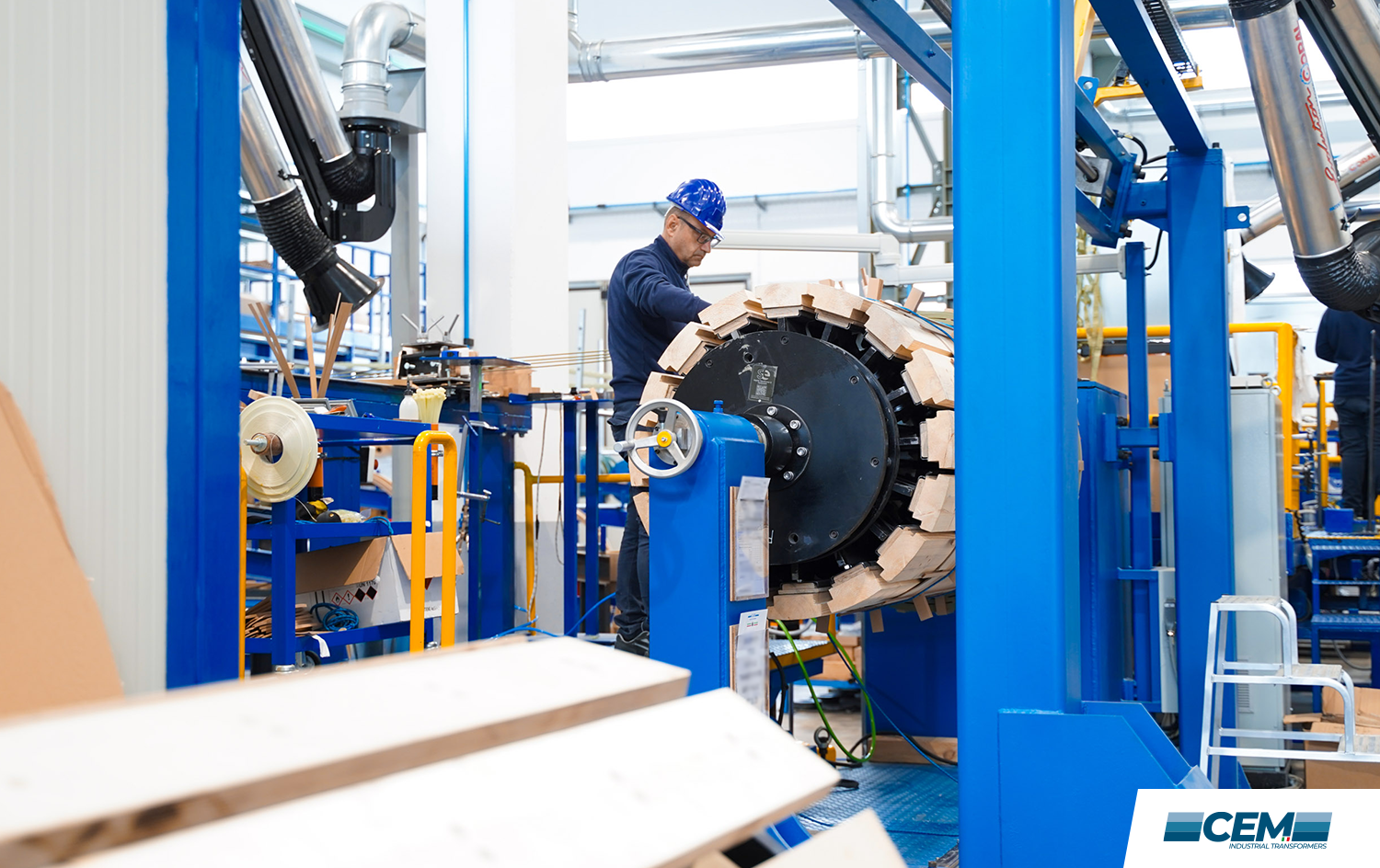
We operate from our facility in Cologno al Serio, Bergamo (Italy). Our winding shop provides in-house copper winding capability for refurbishment programmes, reducing dependence on external suppliers and maintaining quality control over the most critical component of the transformer.
Why choose CEM engineering as your industrial transformer partner
We do one thing: industrial and power system transformers. We do not divide our attention between transformers and switchgear, cables, motors, or general electrical contracting. Every engineer on our team has deep knowledge of transformer technology in demanding industrial applications. That focus is our competitive advantage and it is what our clients in the global steel, aluminium, chemical, and mining industries rely on when their critical transformer assets need support.
ISO 9001 certified, 24/7/365 available, with engineering presence. Contact us to discuss your industrial transformer challenges.
FAQ – Industrial transformers
What is the difference between an industrial transformer and a standard power transformer?
A standard power transformer is designed for sinusoidal currents, steady-state loading, and the well-defined electrical conditions of utility distribution or transmission service. An industrial transformer is engineered for applications that impose conditions outside this scope: non-sinusoidal currents from power electronics, extreme load cycling in arc furnace service, very high secondary currents in electrochemical applications, or continuous full-load operation in DC drive systems. Using a standard transformer in an industrial application leads to predictable failure.
How often should industrial transformers be tested with DGA?
For industrial transformers in heavy service EAF, LF, rectifier DGA analysis should be conducted every three to six months. The higher thermal and mechanical stress of industrial duty accelerates fault development compared with utility service, making more frequent monitoring essential for effective early warning.
When should an industrial transformer be refurbished rather than replaced?
Refurbishment is typically the preferred option when: the transformer is a custom-engineered design with a long replacement lead time; the fault is limited to specific components (OLTC, windings, bushings) that can be replaced without replacing the core and tank; and the insulation system (oil and paper) has remaining useful life. A condition assessment based on DGA history, DP (Degree of Polymerisation) testing of the paper insulation, and visual inspection provides the information needed for this decision.
What is the role of the OLTC in industrial transformer reliability?
The on-load tap changer is typically the most maintenance-intensive component of an industrial transformer and the leading cause of forced outage. In EAF service, the OLTC executes hundreds of operations per day far more than in utility service causing accelerated contact wear and oil contamination. Maintenance must be calibrated by operation count, not just calendar time, to prevent OLTC failure from cascading into a transformer outage.
Does CEM Engineering service industrial transformers from other manufacturers?
Yes. Our service activities cover EAF, LF, rectifier, converter, and industrial supply transformers regardless of the original manufacturer. We provide DGA analysis, OLTC maintenance, winding inspection, failure analysis, and refurbishment support for any oil-immersed industrial transformer, focused on the application and the engineering rather than the nameplate.